


Good Samaritan laws protect individuals from civil lawsuits when they voluntarily help a victim in medical need during an emergency. All 50 states and the District of Columbia have these laws, which shield bystanders acting in good faith from liability for ordinary negligence — but not gross negligence or reckless misconduct.
Good Samaritan laws are state-level statutes that protect bystanders from civil liability when they provide emergency medical aid to someone in need. Every US state plus DC has some version of this law. Protection typically requires four elements: a genuine emergency, voluntary action, good faith, and reasonable care. The laws shield well-meaning helpers from “ordinary negligence” claims if their efforts accidentally cause harm. They do not protect against gross negligence, reckless misconduct, or compensation-based aid.
If you’ve ever hesitated to help someone having a heart attack, choking, or bleeding in public, you’re not alone. The fear of being sued stops many bystanders from acting — even when they could save a life. That’s exactly why Good Samaritan laws exist. This guide explains the law that protects you from civil lawsuits when helping a victim in medical need, how it works in every US state, who is and isn’t covered, what counts as gross negligence, real-world examples, and how to protect yourself while still doing the right thing. Every fact here is drawn from federal and state statutes — no speculation.
Understanding Medical Negligence and Your Rights
When medical care falls below acceptable standards, the consequences can be life-altering. Patients trust healthcare professionals with their well-being, expecting accurate diagnoses, safe procedures, and responsible treatment. Unfortunately, mistakes can happen sometimes due to oversight, lack of communication, or inadequate training. In such situations, it becomes important to understand your rights and explore the legal options available to you. Being informed is the first step toward protecting yourself and your family from further harm.
Why Legal Support Matters in Complex Cases
Medical negligence cases are often complicated, involving detailed records, expert opinions, and strict legal procedures. Without proper guidance, it can be difficult to navigate the system or prove liability. This is where experienced legal professionals come into play. Consulting a qualified medical malpractice attorney Vermont can help you evaluate your case, gather necessary evidence, and pursue fair compensation. Their role is not just about filing claims, but also about ensuring that your voice is heard and your losses are properly acknowledged.
Choosing the Right Path Toward Justice
Selecting the right legal support can make a significant difference in the outcome of your case. It’s important to work with a team that understands both the legal and emotional aspects of medical malpractice. Firms like Sabbeth Law focus on personalized attention, guiding clients through each step with clarity and care. If you believe you or a loved one has been affected, learning more through a trusted resource such as can help you take the next step with confidence and peace of mind.
The Law That Protects Medical Good Samaritans
The answer to the question is clear and consistent across every state: Good Samaritan laws.
What Good Samaritan Laws Do
- Protect bystanders who voluntarily provide emergency aid
- Shield helpers from civil liability for ordinary negligence
- Cover both medical and non-medical emergency assistance (varies by state)
- Exist in all 50 states and the District of Columbia
- Often extend to certain federal contexts (airline flights, food donation)
What Good Samaritan Laws Do NOT Do
- Do not prevent lawsuits from being filed
- Do not protect against gross negligence or willful misconduct
- Do not protect medical professionals acting within their official duties
- Do not cover aid given for compensation
- Do not create a legal duty to help (with four state exceptions)
Key insight: Good Samaritan laws don’t stop someone from suing you – but they give you a very strong legal defense if they do. In most cases, the suit is dismissed quickly.
Why Good Samaritan Laws Exist
Before these laws, many people who could have helped didn’t — fearing a lawsuit from the very person they tried to save.
The Problem Being Solved
- The “Bystander Effect” — witnesses freeze when others are present
- Fear of litigation — liability concerns trumping human instinct
- No common-law duty to rescue — in most states, you’re not required to help
- Real-world consequences — preventable deaths from inaction
The Policy Goal
State legislatures created Good Samaritan laws to reverse this pattern. By removing the fear of being sued, the laws encourage people to act when every second matters — especially in cardiac arrests, choking incidents, drowning, bleeding, and overdoses.
Origin of the Name
The term comes from the Biblical Parable of the Good Samaritan (Luke 10:29–37), in which a Samaritan traveler stops to help a beaten stranger that others ignored. The first modern Good Samaritan law was enacted in California in 1959, originally designed to protect physicians who helped outside their clinical setting.
The Four Elements of Good Samaritan Protection
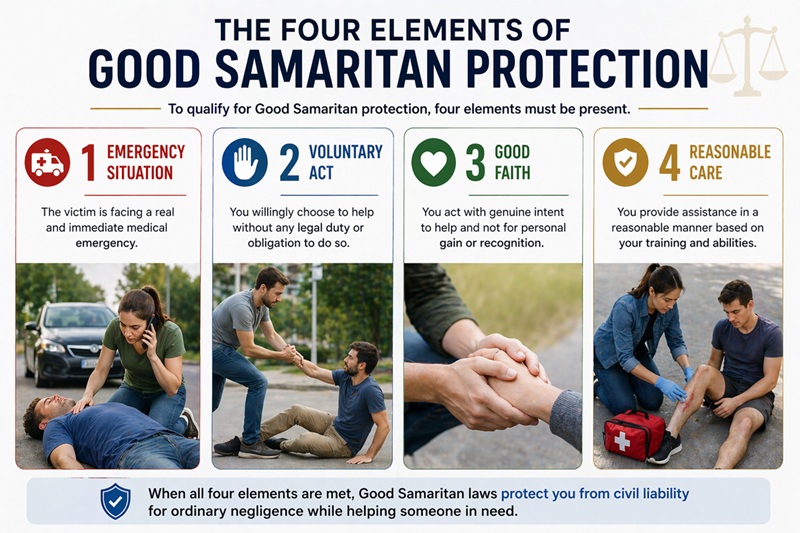
For Good Samaritan immunity to apply, four elements must typically be met. These vary slightly by state but share a common framework.
1. Emergency Situation
The victim must be facing a genuine emergency:
- Heart attack or cardiac arrest
- Stroke
- Car accident injuries
- Choking
- Severe bleeding
- Drug overdose
- Drowning
- Seizure
- Unconsciousness
2. Voluntary Act
The helper must act without any pre-existing duty:
- No contractual obligation (like an on-duty EMT)
- No employer-patient relationship (like an ER doctor at work)
- No creation of the emergency (you didn’t cause the injury)
- No special legal relationship (parent-child, custodian)
3. Good Faith
You must genuinely intend to help, not harm:
- No compensation sought or received
- Reasonable belief the victim needs help
- Sincere attempt to provide aid
4. Reasonable Care
Your actions must meet the “reasonably prudent person” standard:
- Acting within your training level
- Not attempting interventions beyond your ability
- Stopping when professional help arrives
- Not making the situation worse through recklessness
What Good Samaritan Laws Don’t Protect Against
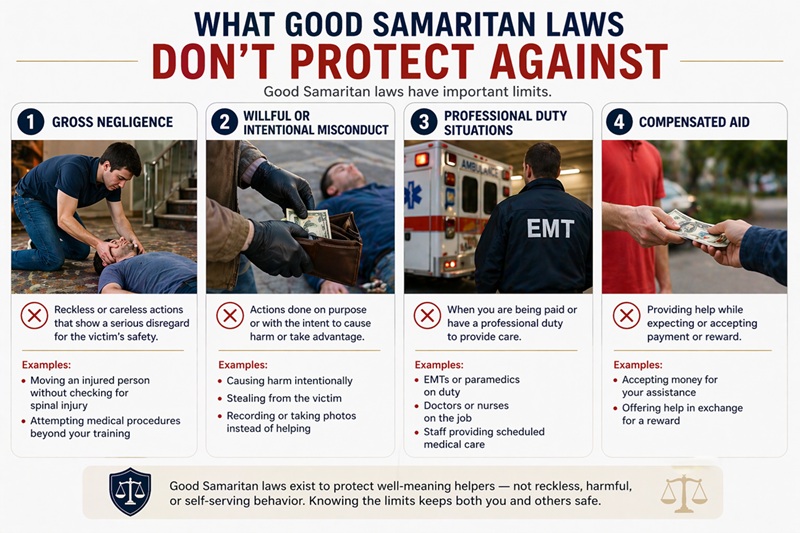
Understanding the exceptions is just as important as knowing the protections.
Gross Negligence
Actions showing reckless disregard for the victim’s safety:
- Performing untrained surgical procedures
- Moving a spinal injury victim carelessly
- Using clearly dangerous methods
- Ignoring obvious signs of worsening harm
Willful or Intentional Misconduct
- Causing harm on purpose
- Using the emergency as cover for abuse
- Stealing from the victim during “aid”
- Taking photos or videos instead of helping
Professional Duty Situations
Medical professionals on the clock are not covered by Good Samaritan laws:
- ER doctors during their shift
- EMTs on a dispatched call
- Nurses providing scheduled patient care
- Paramedics on duty
Compensated Aid
If you receive payment (or expect to), Good Samaritan protection typically doesn’t apply — you’ve become a paid service provider instead of a volunteer.
State-by-State Variations
All 50 states have Good Samaritan laws, but the specifics vary significantly. Here’s how they differ.
Broad Coverage States
These states protect any person who helps in an emergency:
- Virginia
- Pennsylvania
- Delaware
- Florida (under Fla. Stat. § 768.13)
- California (Health & Safety Code § 1799.102)
Restricted Coverage States
Some states limit protection to specific groups:
- Alabama — only trained rescuers and public education employees (except cardiac arrest, which covers anyone)
- Oklahoma — only protects CPR and bleeding control
- Kansas — trained healthcare workers only
- Missouri — trained healthcare workers only
Duty-to-Assist States
Four states actually require bystanders to provide reasonable help:
| State | Statute | Penalty for Failing to Help |
|---|---|---|
| Minnesota | Minn. Stat. § 604A.01 | Petty misdemeanor; fine up to $300 |
| Vermont | 12 V.S.A. § 519 | Fine up to $100 |
| Rhode Island | R.I. Gen. Laws § 11-56-1 | Imprisonment up to 6 months, fine up to $500 |
| Louisiana | Limited duty via La. R.S. 14:73.5 | Varies |
In these states, you must provide “reasonable assistance” if you can do so without endangering yourself.
Federal Good Samaritan Laws
Beyond state laws, several federal statutes provide specific protections.
Aviation Medical Assistance Act (1998)
- What it does: Protects medical professionals and laypersons who provide emergency medical care during commercial flights
- Who’s covered: Any “medically qualified individual” who voluntarily responds to an in-flight emergency
- Key exclusion: Gross negligence or willful misconduct
- Why it matters: In-flight medical emergencies occur on roughly 1 in 600 flights
Bill Emerson Good Samaritan Food Donation Act (1996)
- What it does: Shields food donors from civil and criminal liability when donated food causes harm
- Who’s covered: Individuals, businesses, nonprofits donating food in good faith
- Not medical: But built on the same principle
Good Samaritan Drug Overdose Laws
Many states have expanded Good Samaritan protections to people who call 911 during drug overdoses. These laws typically protect:
- The person calling for help
- The overdose victim
- Bystanders remaining at the scene
From minor drug possession charges — encouraging people to call for help without fear of arrest.
Real-World Examples Where Good Samaritan Laws Apply
Example 1: Heart Attack in a Restaurant
A customer collapses from cardiac arrest. You perform CPR and accidentally break a rib (common in effective CPR). You’re protected — CPR injuries during a good-faith rescue fall squarely within Good Samaritan protection.
Example 2: Car Accident Aid
You stop at a highway accident and help move an injured driver away from a burning car. If the driver later has a neck injury, Good Samaritan laws protect you in most states — assuming you acted reasonably under the emergency.
Example 3: Drug Overdose
You find a friend unconscious from an opioid overdose and administer Narcan while calling 911. Good Samaritan drug overdose laws protect both you and the victim from certain drug-related charges.
Example 4: Choking Incident
You perform the Heimlich maneuver on a choking victim and accidentally bruise their ribs. Protected.
Example 5: Drowning Rescue
You pull an unresponsive swimmer from a pool. Even if resuscitation attempts fail or cause injury, Good Samaritan laws shield good-faith efforts.
When the Law Won’t Protect You: Real Counterexamples
The California Spinal Injury Case
A well-publicized California case involved a woman who pulled a coworker from a car after a crash, causing permanent spinal injury. The court found she acted unreasonably under the circumstances. California law later amended its Good Samaritan provisions to clarify non-medical rescue protection, but the case remains a cautionary tale about reckless action even with good intentions.
Lessons from Edge Cases
- Moving an accident victim unnecessarily can be considered reckless
- Performing medical procedures beyond your training may forfeit protection
- Helping while intoxicated undermines “reasonable care”
- Filming or photographing instead of helping removes any immunity
Good Samaritan Laws for Medical Professionals
The rules work differently for doctors, nurses, and EMTs.
On-Duty Protection
When medical professionals are working within their normal job duties, they’re typically governed by:
- Medical malpractice standards
- Employer liability rules
- Professional licensing requirements
Good Samaritan laws don’t apply in these situations.
Off-Duty Protection
When medical professionals voluntarily help during emergencies outside their workplace:
- Good Samaritan laws typically DO apply
- They get the same protection as any bystander
- Many state laws specifically mention medical professionals by name
The Volunteer Exception
Some state laws extend Good Samaritan protection to medical professionals when they volunteer — even if doing work that would normally be considered their professional duty. For example, volunteering at a free clinic or disaster response.
How to Maximize Your Good Samaritan Protection
If you stop to help, take these steps to strengthen your legal position.
- Call 911 first — document that professional help is coming
- Ask for consent when the victim is conscious
- Stay within your training — don’t attempt what you don’t know
- Act as a reasonable person would — no heroic overreach
- Avoid moving accident victims unless there’s immediate danger (fire, drowning)
- Stay until help arrives — leaving mid-rescue can jeopardize protection
- Document the incident mentally — details you may need later
- Turn the victim over to EMTs — don’t second-guess their professional response
- Don’t accept payment — keeps your “volunteer” status clear
- Never use the situation for personal gain — no photos, no social media
Implied Consent: When the Victim Can’t Agree
In many emergencies, the victim is unconscious, disoriented, or otherwise unable to consent to help. Good Samaritan laws address this through the doctrine of implied consent.
How Implied Consent Works
The law presumes that:
- A reasonable person would want help in an emergency
- Unconscious victims have impliedly consented to reasonable aid
- The nature and severity of the emergency justifies immediate action
Important Limitations
- If a conscious victim refuses help, you must respect their refusal
- Implied consent does not apply when explicit objections are made
- Religious or medical directives (like a DNR) may limit consent
- Parental consent may apply for minors, but emergencies still permit lifesaving aid
How Good Samaritan Laws Compare to Other Legal Doctrines
| Doctrine | What It Does | Where It Applies |
|---|---|---|
| Good Samaritan Law | Protects voluntary rescuers from civil suits | All 50 states + DC |
| Duty to Rescue | Requires reasonable aid | MN, VT, RI, LA (limited) |
| Implied Consent | Allows aid to unconscious victims | Common law, all states |
| Medical Malpractice | Governs care by paid professionals | All states |
| Respondeat Superior | Employer liability for employee acts | Common law |
What to Do If You’re Sued After Helping
Even with Good Samaritan laws, lawsuits can still be filed. Here’s how to respond.
- Don’t panic — the law is designed to protect you
- Contact your homeowner’s or umbrella insurance — these often cover Good Samaritan defense
- Hire a personal injury defense attorney — many offer free initial consultations
- Gather documentation — any witnesses, photos, medical reports, 911 call records
- File a motion to dismiss based on Good Samaritan statute
- Don’t settle quickly — the law gives you strong defenses
- Document everything about the incident in writing while memories are fresh
FAQs
1. Does the Good Samaritan Law protect you if something goes wrong while helping?
Yes — as long as you acted in good faith, within your training, and without gross negligence. The law specifically protects against ordinary mistakes during emergency aid. If you break a rib performing CPR or cause minor injury during a rescue attempt, you’re protected. Intentional harm or reckless disregard is not covered.
2. Can I be sued even if the Good Samaritan Law protects me?
Yes. The law provides a defense — not a shield against lawsuits being filed. Anyone can file a lawsuit, but if your actions meet Good Samaritan requirements, the case should be dismissed. You may still need to hire an attorney to invoke the defense. Homeowner’s insurance often covers these legal costs.
3. Am I legally required to help in a medical emergency?
In most states, no. Common law generally doesn’t impose a duty to rescue. However, four states — Minnesota, Vermont, Rhode Island, and Louisiana — require bystanders to provide reasonable assistance when it can be done safely. Professional relationships like parent-child, doctor-patient, or on-duty roles may also create a legal duty.
4. Does the Good Samaritan Law cover CPR and AED use?
Yes. CPR and AED (automated external defibrillator) use are classic Good Samaritan scenarios. Most states have specific AED laws providing additional protection for people who use publicly accessible defibrillators during emergencies. Rib fractures and other common CPR-related injuries are explicitly covered under most state Good Samaritan statutes.
5. Are medical professionals protected when helping off-duty?
Generally, yes. When doctors, nurses, or EMTs voluntarily help during emergencies outside their workplace, Good Samaritan laws typically apply the same way they apply to any bystander. Some states have specific provisions extending protection to medical professionals acting as volunteers. On-duty professional care remains governed by medical malpractice standards.
6. Do Good Samaritan Laws protect against drug overdose situations?
Yes. Many states have Good Samaritan drug overdose laws that protect both the person calling 911 and the overdose victim from certain drug-possession charges. These laws are designed to encourage calling for help without fear of arrest. Protection typically requires staying at the scene and cooperating with responders.
7. Does the Good Samaritan Law apply during flights?
Yes. The federal Aviation Medical Assistance Act of 1998 specifically protects medically qualified individuals who voluntarily respond to in-flight emergencies. The protection covers gross negligence only in extreme cases, offering strong liability protection for off-duty medical professionals who help during commercial flights.
Key Takeaways
- Good Samaritan laws protect bystanders from civil lawsuits when helping in medical emergencies
- All 50 states and DC have some version of the law
- Protection requires an emergency, voluntary action, good faith, and reasonable care
- Laws protect against ordinary negligence — not gross negligence or willful misconduct
- Minnesota, Vermont, Rhode Island, and Louisiana require bystanders to provide reasonable help
- Medical professionals are generally covered off-duty but not on-duty
- Federal protections apply to aviation emergencies and food donations

