


A generational equity lawsuit is legal action that challenges policies or resource allocations claiming they unfairly burden future generations — particularly in areas like climate change, national debt, pension systems, and environmental protection laws.
A generational equity lawsuit argues that current laws, government decisions, or corporate actions create disproportionate costs or harms for younger and future generations. These lawsuits often target climate inaction, unsustainable fiscal policy, or depleted natural resources. Courts in several countries — including India, the Netherlands, and the United States — have heard such cases, with some resulting in landmark rulings.
5-Bullet Summary:
- Generational equity lawsuits seek justice for future or younger generations harmed by current policies
- Common targets include climate change inaction, pension deficits, and environmental degradation
- Landmark cases like Urgenda v. Netherlands and India’s M.C. Mehta rulings set key precedents
- Courts increasingly recognize “intergenerational equity” as a legal doctrine, not just a concept
- These lawsuits are growing globally, including in India under constitutional environmental law
Decisions made today shape the world that tomorrow’s children will inherit. Generational equity lawsuits put that principle into a courtroom. Whether it’s a government failing to act on climate change, a pension system draining public funds, or industrial pollution poisoning water sources — courts are being asked to answer a hard question: Can future generations have legal rights today?
This article explains what generational equity lawsuits are, the legal framework behind them, real-world case studies, how they apply in India, and what you need to know if you’re a student, lawyer, policy researcher, or concerned citizen.
What Is a Generational Equity Lawsuit?
A generational equity lawsuit is a legal claim filed on behalf of current younger generations or hypothetical future generations, arguing that a government, corporation, or institution has acted — or failed to act — in a way that unfairly transfers costs, risks, or harms onto people who haven’t yet had a voice in those decisions.
The underlying principle is intergenerational equity — the idea that present generations hold resources in trust for those who come after them.
The Legal Doctrine of Intergenerational Equity
The doctrine of intergenerational equity was formally articulated by international environmental lawyer Edith Brown Weiss in her 1989 work In Fairness to Future Generations. It holds three core obligations:
- Conservation of options — Don’t reduce the diversity of natural resources available to future generations
- Conservation of quality — Leave the planet in no worse condition than you received it
- Conservation of access — Ensure future generations can access what past and present generations enjoyed
This doctrine has since found expression in national constitutions, international agreements, and court rulings across the world.
Why Are Generational Equity Lawsuits Filed?
These lawsuits arise when normal democratic or legislative channels fail to protect future interests. Key triggers include:
- Climate inaction — Governments that fail to meet emissions targets
- Pension fund mismanagement — Promises made to retirees that burden working-age and younger citizens
- National debt — Fiscal policies that accumulate unsustainable debt for future taxpayers
- Environmental destruction — Deforestation, water depletion, soil degradation
- Nuclear waste storage — Long-term hazards that outlive current decision-makers
Landmark Generational Equity Lawsuits Around the World
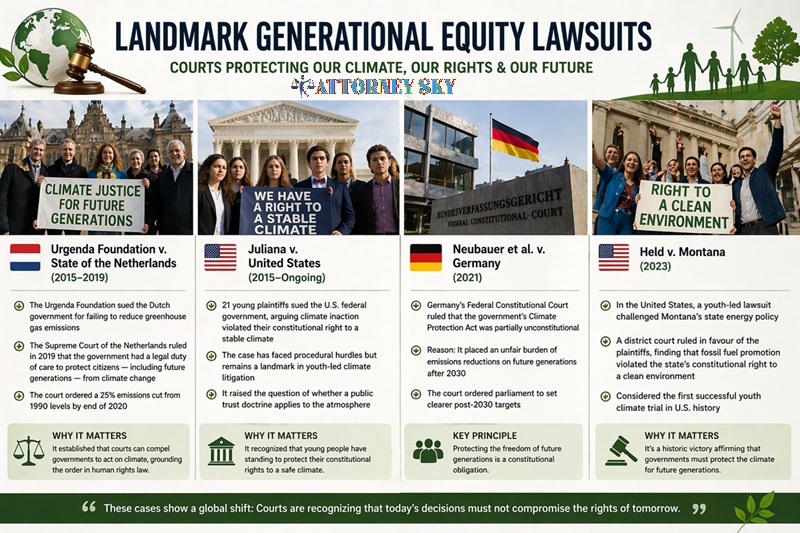
Urgenda Foundation v. State of the Netherlands (2015–2019)
One of the most cited climate lawsuits globally.
- The Urgenda Foundation sued the Dutch government for failing to reduce greenhouse gas emissions
- The Supreme Court of the Netherlands ruled in 2019 that the government had a legal duty of care to protect citizens — including future generations — from climate change
- The court ordered a 25% emissions cut from 1990 levels by end of 2020
Why it matters: It established that courts can compel governments to act on climate, grounding the order in human rights law.
Juliana v. United States (2015–Ongoing)
- 21 young plaintiffs sued the U.S. federal government, arguing climate inaction violated their constitutional right to a stable climate
- The case has faced procedural hurdles but remains a landmark in youth-led climate litigation
- It raised the question of whether a public trust doctrine applies to the atmosphere
Neubauer et al. v. Germany (2021)
- Germany’s Federal Constitutional Court ruled that the government’s Climate Protection Act was partially unconstitutional
- Reason: It placed an unfair burden of emissions reductions on future generations after 2030
- The court ordered parliament to set clearer post-2030 targets
Key principle: Protecting the freedom of future generations is a constitutional obligation.
Held v. Montana (2023)
- In the United States, a youth-led lawsuit challenged Montana’s state energy policy
- A district court ruled in favour of the plaintiffs, finding that fossil fuel promotion violated the state’s constitutional right to a clean environment
- Considered the first successful youth climate trial in U.S. history
Generational Equity Lawsuits in India
India has a rich tradition of Public Interest Litigation (PIL) that has repeatedly invoked the intergenerational equity doctrine.
Constitutional Foundation in India
The legal basis for generational equity claims in India rests on:
- Article 21 — Right to life, interpreted broadly to include the right to a clean environment
- Article 48A — Directive Principle requiring the state to protect the environment
- Article 51A(g) — Fundamental Duty to protect the natural environment
M.C. Mehta v. Union of India (Multiple Rulings)
Advocate M.C. Mehta has filed landmark PILs that implicitly or explicitly protect future generations:
- Ganga Pollution Case — Directed closure of tanneries polluting the Ganga river
- Taj Trapezium Case — Protected the Taj Mahal from acid rain caused by nearby industries
- Vehicular Pollution Case — Led to CNG mandates for Delhi’s public transport
The Supreme Court in these cases repeatedly cited the duty of present generations to preserve environmental assets for those who follow.
T.N. Godavarman Thirumulpad v. Union of India (1995–Ongoing)
One of the longest-running environmental cases in Indian legal history. The Supreme Court essentially took over management of India’s forests to prevent destruction that would deprive future generations of forest resources.
Vellore Citizens Welfare Forum v. Union of India (1996)
The Supreme Court explicitly adopted the precautionary principle and polluter pays principle, stating that sustainable development — which includes intergenerational equity — is part of Indian environmental law.
The court held: “The ‘Precautionary Principle’ and the ‘Polluter Pays Principle’ are essential features of ‘Sustainable Development’.”
Recent Climate PILs in India
- Petitions filed before the Supreme Court and High Courts increasingly cite India’s climate commitments under the Paris Agreement
- In 2024, the Supreme Court recognised the right against adverse effects of climate change as a fundamental right under Articles 14 and 21
Comparison Table — Generational Equity Lawsuits Across Countries
| Country | Case | Year | Issue | Outcome |
|---|---|---|---|---|
| Netherlands | Urgenda v. Netherlands | 2015–2019 | Climate emissions | Government ordered to cut emissions 25% |
| USA | Juliana v. United States | 2015–ongoing | Fossil fuel policy | Ongoing; procedural battles |
| Germany | Neubauer v. Germany | 2021 | Climate Act gaps | Parliament ordered to set post-2030 targets |
| USA (Montana) | Held v. Montana | 2023 | State energy policy | Youth plaintiffs won |
| India | M.C. Mehta v. UoI | 1985–ongoing | Pollution/forests | Multiple environmental protections ordered |
| India | Godavarman v. UoI | 1995–ongoing | Forest conservation | Supreme Court oversight of forests |
| Pakistan | Leghari v. Federation | 2015 | Climate implementation | Government ordered to implement climate policy |
How to File a Generational Equity Lawsuit in India
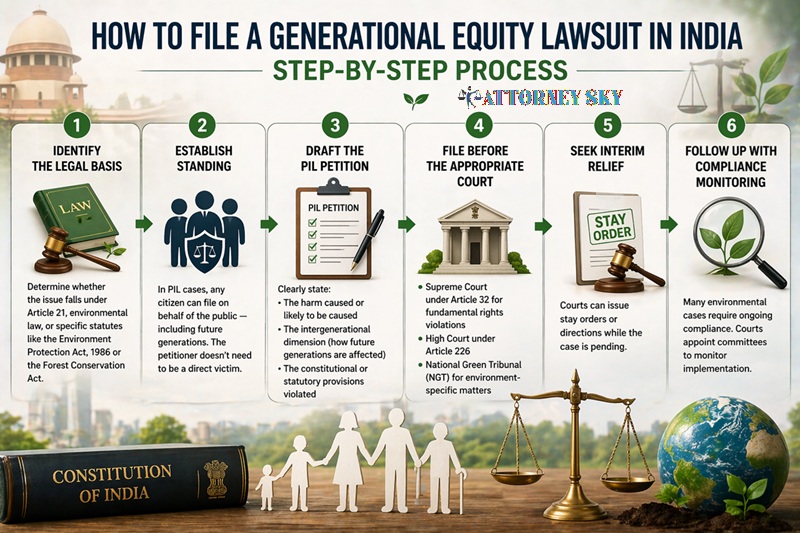
Step-by-Step Process
Step 1 — Identify the legal basis Determine whether the issue falls under Article 21, environmental law, or specific statutes like the Environment Protection Act, 1986 or the Forest Conservation Act.
Step 2 — Establish standing (locus standi) In PIL cases, any citizen can file on behalf of the public — including future generations. The petitioner doesn’t need to be a direct victim.
Step 3 — Draft the PIL petition Clearly state:
- The harm caused or likely to be caused
- The intergenerational dimension (how future generations are affected)
- The constitutional or statutory provisions violated
Step 4 — File before the appropriate court
- Supreme Court under Article 32 for fundamental rights violations
- High Court under Article 226
- National Green Tribunal (NGT) for environment-specific matters
Step 5 — Seek interim relief Courts can issue stay orders or directions while the case is pending.
Step 6 — Follow up with compliance monitoring Many environmental cases require ongoing compliance. Courts appoint committees to monitor implementation.
Challenges Facing Generational Equity Lawsuits
Legal Barriers
- Standing issues — Can unborn generations be legal persons?
- Justiciability — Courts may refuse to rule on political/policy matters
- Causation — Linking specific policies to future harm is difficult
- Enforcement — Even if courts rule in favour, implementation can be weak
Political and Institutional Resistance
- Governments often argue courts are overstepping into legislative domain
- Industries challenge such lawsuits as economically damaging
- Long case timelines mean harm may occur before judgments are delivered
The Future of Generational Equity Litigation
Global Trends
- The number of climate-related lawsuits worldwide has more than doubled since 2017
- Courts in Pakistan, Colombia, Australia, and South Africa have all engaged with intergenerational equity principles
- The UN Human Rights Council recognised the right to a clean, healthy, and sustainable environment in 2021
India’s Emerging Role
India’s large youth population (over 600 million under 25) and severe climate vulnerability make it fertile ground for generational equity claims. With the Supreme Court’s 2024 ruling linking climate change to fundamental rights, expect more such litigation in coming years.
FAQs on Generational Equity Lawsuits
What is the meaning of intergenerational equity in law?
Intergenerational equity in law means that present generations must not make decisions that unjustly deprive future generations of resources, rights, or a stable environment. It imposes a legal and ethical duty on governments and corporations to consider long-term consequences of their actions. Indian courts have recognised it as part of environmental law since the 1990s.
Can future generations sue in Indian courts?
Future generations cannot directly sue since they don’t yet exist as legal persons. However, existing citizens — including children and young adults — can file PILs on their behalf under Article 32 or 226. NGOs, lawyers, and concerned citizens can act as representatives for future generational interests.
What is the difference between intergenerational equity and environmental justice?
Environmental justice focuses on fair distribution of environmental benefits and burdens among current communities, especially marginalised groups. Intergenerational equity extends this concern across time — ensuring future generations aren’t left with the costs of today’s decisions. Both concepts often overlap in climate lawsuits.
Is there a specific law for generational equity in India?
India has no standalone “generational equity” statute. However, the principle is embedded in constitutional provisions (Articles 21, 48A, 51A), the Environment Protection Act 1986, the National Green Tribunal Act 2010, and India’s international commitments under the Paris Agreement and Rio Declaration (Principle 3).
What was the first successful generational equity lawsuit?
The Urgenda Foundation v. State of the Netherlands case (2015–2019) is widely regarded as the first major successful generational equity/climate lawsuit where a court ordered a government to take specific emission-reduction action based on duty of care owed to current and future citizens.
Can a child file a generational equity lawsuit in India?
Yes. A minor can file a PIL through a “next friend” (usually a parent or guardian). Several Indian environmental cases have involved child petitioners. The National Green Tribunal has also accepted petitions from young people citing threats to their future environment.
How does the National Green Tribunal handle generational equity cases?
The NGT, established under the NGT Act 2010, handles cases involving substantial environmental questions. It can award compensation, direct remediation, and issue preventive orders. While it doesn’t use the term “generational equity” explicitly, its mandate to protect the environment for present and future generations aligns directly with the doctrine.
Key Takeaways
- Generational equity lawsuits challenge policies that shift costs, risks, or environmental harms onto future generations
- The legal doctrine of intergenerational equity is recognised in Indian constitutional law through Articles 21, 48A, and 51A
- India has produced landmark environmental judgments — M.C. Mehta cases, Vellore Citizens, and Godavarman — that protect future generational interests
- Globally, courts in the Netherlands, Germany, and USA have ruled governments must act on climate for future generations
- In India, Public Interest Litigation (PIL) is the most effective tool to bring generational equity claims
- The National Green Tribunal and Supreme Court are the primary forums for such cases in India
- The 2024 Supreme Court ruling linking climate change to Articles 14 and 21 marks a new frontier for Indian generational equity law

